
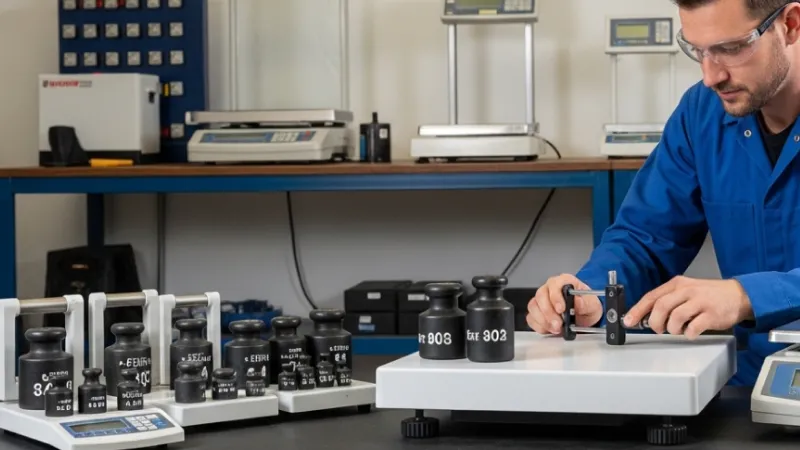
As Rezonans Kalibrasyon, we provide scale and balance calibration services in accordance with international standards to ensure that weighing systems used in industrial and laboratory environments perform accurate and reliable measurements. Measurement accuracy is of critical importance for quality management systems, production processes, and legal requirements. Therefore, all our calibration procedures are performed using reference weights with established international traceability.
Scale calibrations are generally performed in the environment where the device is located (on-site calibration). This method helps achieve more reliable results by ensuring the scale’s accuracy is checked under its actual operating conditions.
During calibration procedures, E2, F1, and M1 class reference weights with traceability to international SI units are used. The appropriate weight class is determined by considering the scale’s capacity, resolution, and intended use. Calibration processes are carried out using weights selected according to the OIML R 111 reference weight standard table and in line with the EURAMET cg-18 calibration guide. With this method, the calibration of scales with capacities up to 5000 kg is performed in a reliable and traceable manner.
An official Scale Calibration Certificate is issued for devices that complete the calibration process and meet compliance requirements. This certificate is a vital document for quality management systems (ISO processes), audits, and legal requirements.
As Rezonans Kalibrasyon, we offer calibration services for a wide range of devices:
With our expert technical team and traceable reference equipment, we provide professional calibration services to laboratories, production facilities, logistics centers, healthcare institutions, and the retail sector.
Regular calibration guarantees that your weighing systems perform stable and reliable measurements over the long term.
Depending on the scale’s usage intensity, its environment, and quality management systems, it is generally recommended to perform calibration at least once a year. This period may be shorter for critical measurements.
The calibration duration varies depending on the device’s capacity and precision. For most scales, the process is completed within 30 minutes to a few hours.
Yes. On-site calibration services are offered for many scales at the location where the device is situated. This eliminates the need to transport the device and allows accuracy to be checked according to actual usage conditions.
A Scale Calibration Certificate containing traceable measurement results is issued for devices that have completed the calibration process.
No. Calibration is the process of determining the measurement accuracy of the device. Adjustment is a technical intervention performed to correct the device’s measurement error. If an adjustment is needed during calibration, it is reported accordingly.

