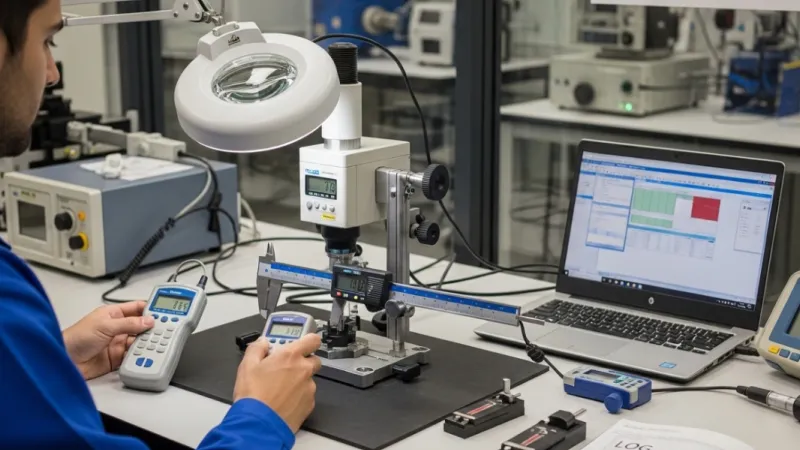
In everyday language, the word uncertainty often carries a negative connotation. It implies a lack of clarity, low reliability, or a fickle situation—essentially, a flaw or a mistake.
However, in technical fields—specifically within measurement and testing processes—measurement uncertainty has a completely different meaning. In this context, uncertainty doesn’t mean a measurement is “wrong.” Instead, it is a scientific parameter that defines the range and confidence level within which a measurement result is valid.
Rather than weakening the reliability of a result, measurement uncertainty acts as a critical indicator that increases scientific accuracy and transparency.
Measurement uncertainty is a parameter associated with the result of a measurement that characterizes the dispersion of the values that could reasonably be attributed to the quantity being measured.
To put it simply, measurement uncertainty defines:
Every measurement involves minor variations due to factors such as instrument sensitivity, environmental conditions, the specific measurement method used, and human factors. Measurement uncertainty calculates the impact of these variables to establish the “trust boundaries” of the result.
In scientific metrology and quality management systems, providing a single numerical value is rarely enough. Without an uncertainty value, a measurement result lacks the context needed to prove its accuracy.
By reporting uncertainty, organizations can:
In laboratory work, industrial production, and scientific research, reporting measurement uncertainty is not just a best practice—it is a fundamental requirement.
When a measurement result is presented alongside its uncertainty value, it indicates that the “true value” exists within a specific interval. This creates a transparent, scientific boundary for the data.
Imagine a measurement is reported as follows:
This means there is a high probability that the actual true value lies somewhere between 98 and 102 units. This approach provides a much more honest and technically sound representation of the data than a single, static number.
Uncertainty doesn’t just provide a range; it also defines the Confidence Level. This represents the statistical probability that the true value falls within the stated range.
In most professional laboratories and quality systems, a 95% confidence level is the standard. This signifies that we are 95% certain the actual value is contained within the reported uncertainty interval.
Understanding this concept is vital for technical decision-making, as it allows engineers and scientists to account for risk and precision simultaneously.
In conclusion, measurement uncertainty is not a sign of doubt—it is a mark of metrological quality. By acknowledging and quantifying the limits of a measurement, institutions demonstrate a commitment to precision, transparency, and international excellence.